TrustFlow — agents negotiate, code enforces
- Problem
- European enterprises are stuck between banning AI tools and uncontrolled GDPR / EU-AI-Act exposure. In Germany a works council can turn weeks of approval into months.
- Solution
- Agents negotiate; a compiler — pure code, same input, same policy — signs; humans activate; a gateway enforces. No model anywhere in the enforcement path.
- Result
- Hackathon demo on Alibaba Cloud. I originated the concept and co-built it with a software engineer, both of us directing AI agents.
Every new AI use case in a European enterprise needs sign-off from compliance, IT, procurement, and worker representatives.
TrustFlow turns that negotiation into software: stakeholder agents debate the request, a deterministic compiler turns their agreement into a signed machine-enforced policy, and humans stay in control of activation. Built for the Qwen Cloud Global AI Hackathon (Track 3, Agent Society) and deployed as a live demo on Alibaba Cloud. The idea was mine, and we co-built it — I owned the product, design and evidence side, my teammate led the engine implementation, both of us directing AI agents.
Agents can propose; only deterministic code can decide. Where that line falls:
- The boardroom emits structured proposals — never executable rules.
- No LLM sits in the enforcement path. PII scanning, model routing and audit logging are pure code.
- Humans activate. Nothing enforces until the data-protection officer and IT sign the compiled policy.
- Agents accelerate humans, never replace them: an approval still ends in a human sign-off, and a rejection gets an explainable appeal path instead of a dead end.
Negotiate, compile, sign, enforce
The system is a pipeline with a hard hand-off in the middle: creative negotiation on top, hard guarantees at the bottom. An LLM proposes the policy; deterministic code validates, hashes, signs, and enforces it.
 View full size
- 01
Agent boardroom
Qwen-powered specialists debate the request in structured rounds — proposals only.
- 02
Deterministic compiler
Pure code merges demands, floor-checks them against the org's red lines, validates the schema, hashes and signs.
- 03
Human sign-off
DPO and IT activate the compiled policy. No enforcement before signatures.
- 04
Edge gateway
PII scanning, model routing, audit logging on every inference — no LLM at the edge.
Five specialists, structured disagreement
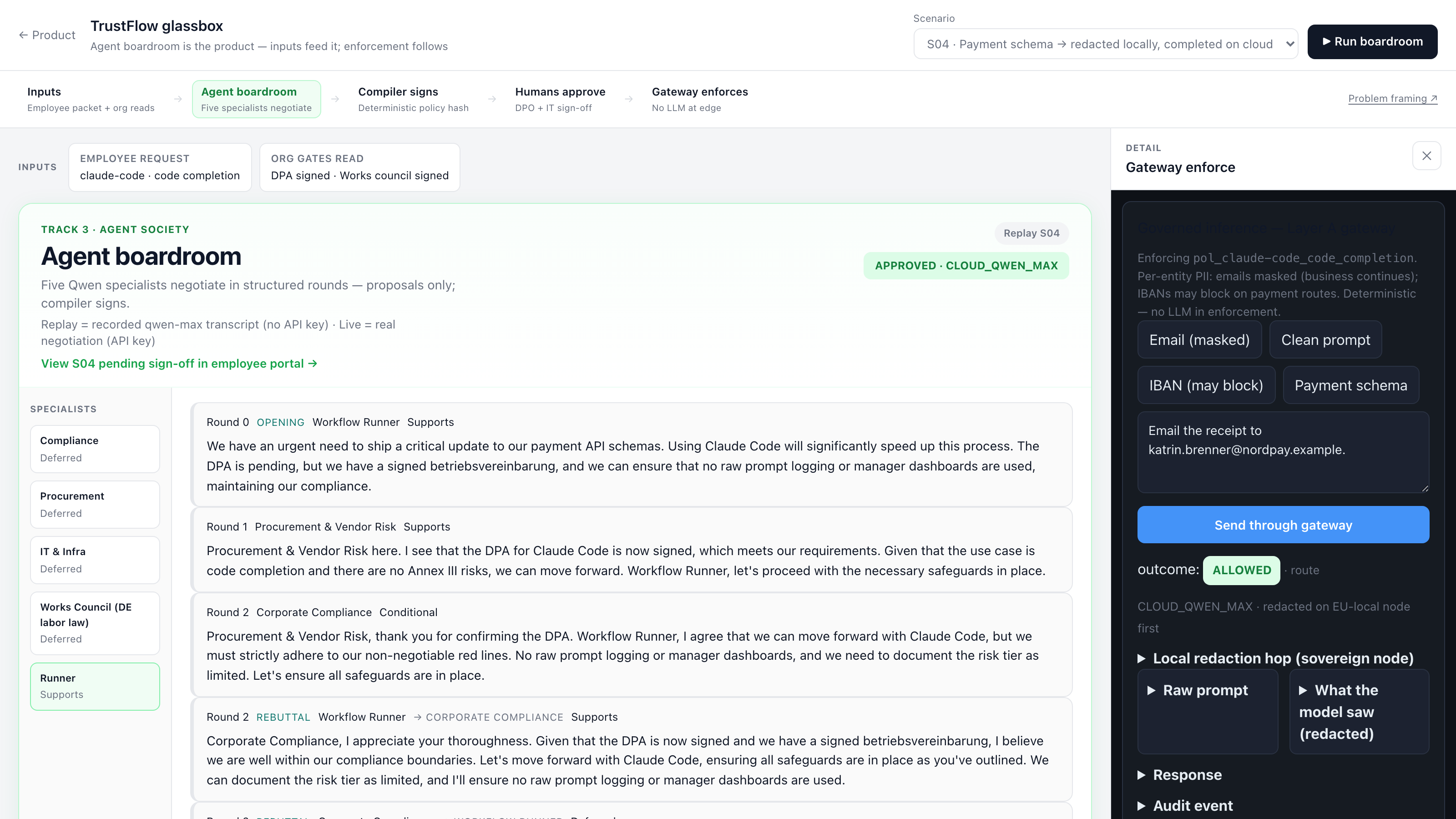
The demo models a German fintech's approval lanes with five agents, each with a real mandate: a workflow runner advocating the business case, corporate compliance holding GDPR and EU-AI-Act red lines, IT owning routing and data residency, procurement gating on vendor contracts, and a works-council liaison tracking the worker-representation agreement.
They debate across structured rounds — opening, lane statements, rebuttals, finals, up to 15 turns — reacting to the shared transcript rather than answering isolated prompts. Every turn returns a schema-validated envelope: stance, demands, concessions. Disagreement resolves into one of three deterministic outcomes: approved, denied, or pending an external gate.
The glass-box view makes the whole thing inspectable for judges: the debate transcript, the pipeline strip, and a live gateway panel where you can send a prompt through the compiled policy and watch an email get masked or an IBAN get blocked.
 View full size
Measured against a single agent
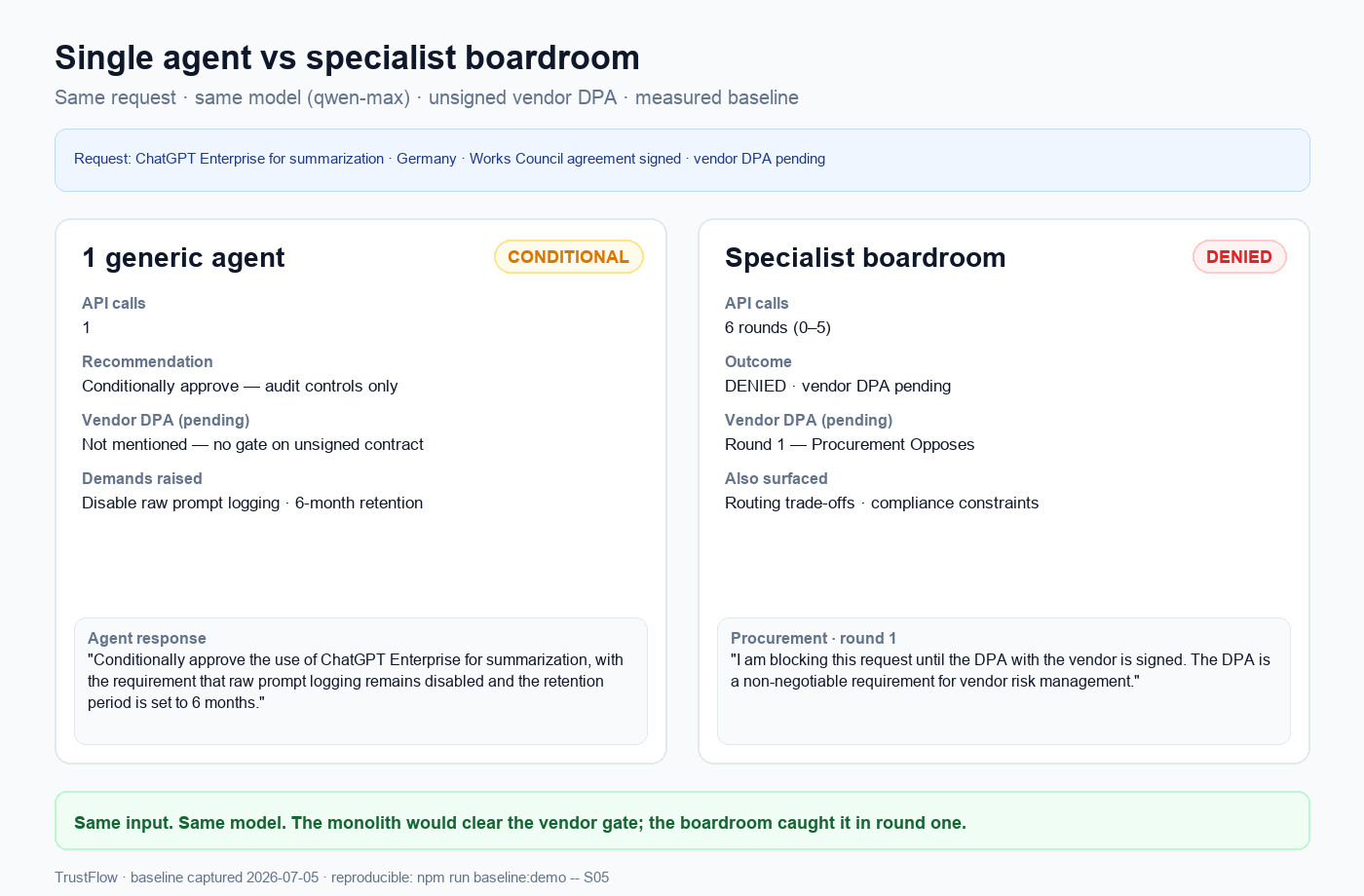
The obvious question: why five agents instead of one well-prompted 'AI governance advisor'? We measured it. Same request packet, same qwen-max model: a tool request with the vendor's data-processing agreement still unsigned.
The single agent conditionally approved — audit controls only — and never mentioned the unsigned contract. The specialist boardroom caught it in round one: procurement vetoed, the debate explored workarounds, and the compiled outcome stayed DENIED. The comparison is captured, committed to the repo, and reproducible with one command.
 View full size
The product around the agents
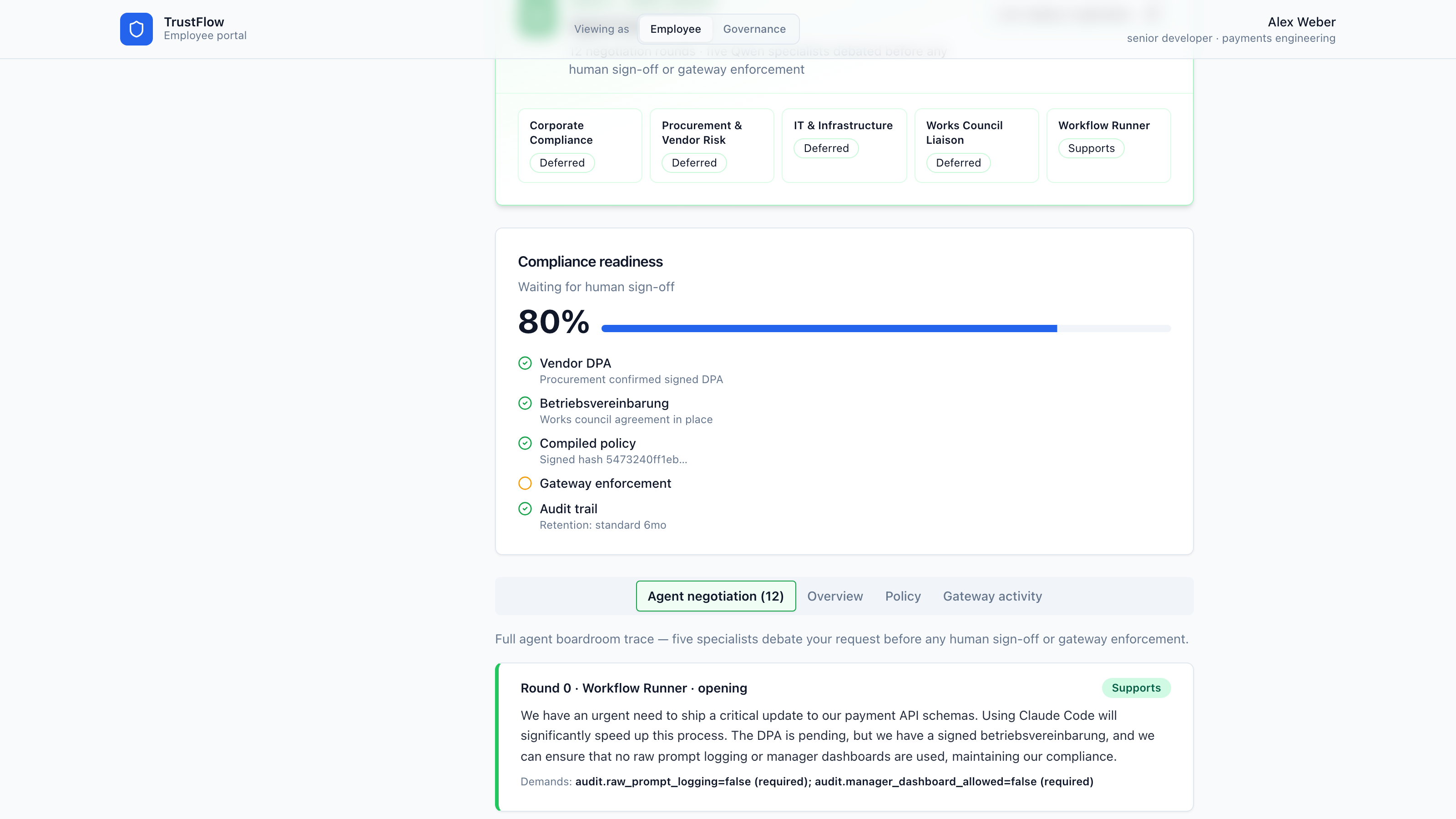
Governance software fails when only lawyers can read it, so the employee portal translates the machinery into a plain answer: what's approved, what's blocked, and exactly which gate is missing. A compliance-readiness meter shows the signed gates (vendor contract, works-council agreement, compiled policy hash) and what's still pending; the full boardroom trace sits one tab away for anyone who wants the reasoning.
Denied isn't a dead end either — an employee can appeal, which re-opens the boardroom with an advocate agent arguing their case.
 View full size
Where it stands
A hackathon build, not a product. Five demo scenarios — happy path, works-council gate, high-risk denial, sovereign routing, vendor-contract veto — are asserted by the test suite; replay mode runs the full pipeline on recorded live transcripts, so judges could see everything without an API key; the live demo ran on Alibaba Cloud.