Lesson templates that couldn't break live classes
- Problem
- Lesson structure couldn't flex as markets expanded. New templates risked breaking what students already used.
- Solution
- Four composable blocks with contracts: authors configure the lesson; the apps students and teachers use stay stable.
- Result
- Shipped to production on a four-block contract, stress-tested against UAE Ministry of Education and Indonesia rollout flows before build. The cross-team design review I started outlived the project.
Role & team
Led design of the authoring and admin experience
- With product owners and engineering; supported the junior designers on the team.
- Started the cross-team design review that outlived the project.
Duration & scope
2020–2022, four composable blocks
- The authoring system behind lesson templates across expanding markets.
- Stress-tested against UAE Ministry of Education and Indonesia rollout flows before build.
The constraint
Live classes could not break
- Students were already inside the lessons this system authored — a breaking change would land in a live class.
Students were already inside the lessons this system authored — a breaking change would land in a live class. Alef, an adaptive-learning EdTech company, was expanding into new markets faster than its lesson structure could flex, and authors needed to compose lessons without engineering in the loop.
I led the design of the authoring and admin experience, working with product owners and engineering, and supported the junior designers on the team.
The architecture of lesson building blocks
We audited existing lesson structures and ran stakeholder interviews until the complexity collapsed into four composable units — the information architecture of every lesson the system could author. Each block carried a clear contract: what authors could configure, what data consumer apps would receive, and what could never be mixed.
Video, HTML, and rich media. Passive delivery — no learner actions tracked.
Translating legacy into config
Every legacy structure was reverse-engineered into generic patterns authors could reason about — and developers could implement once. That translation layer is what let us scope the project without guessing: authors saw familiar building blocks, engineering saw a finite configuration space.
The default authoring surface — outline, canvas, and inspector working as one coherent layout.
Stress-testing regional branch logic
Markets don't share the same curriculum logic. Before build, we mapped author configurations against real regional flows — MOE requirements, Indonesia rollout paths, and edge cases from simple linear lessons to asymmetric branching.
Templates aligned to Ministry of Education curriculum — compliance as a configuration constraint, not a custom build.
The shipped authoring surface
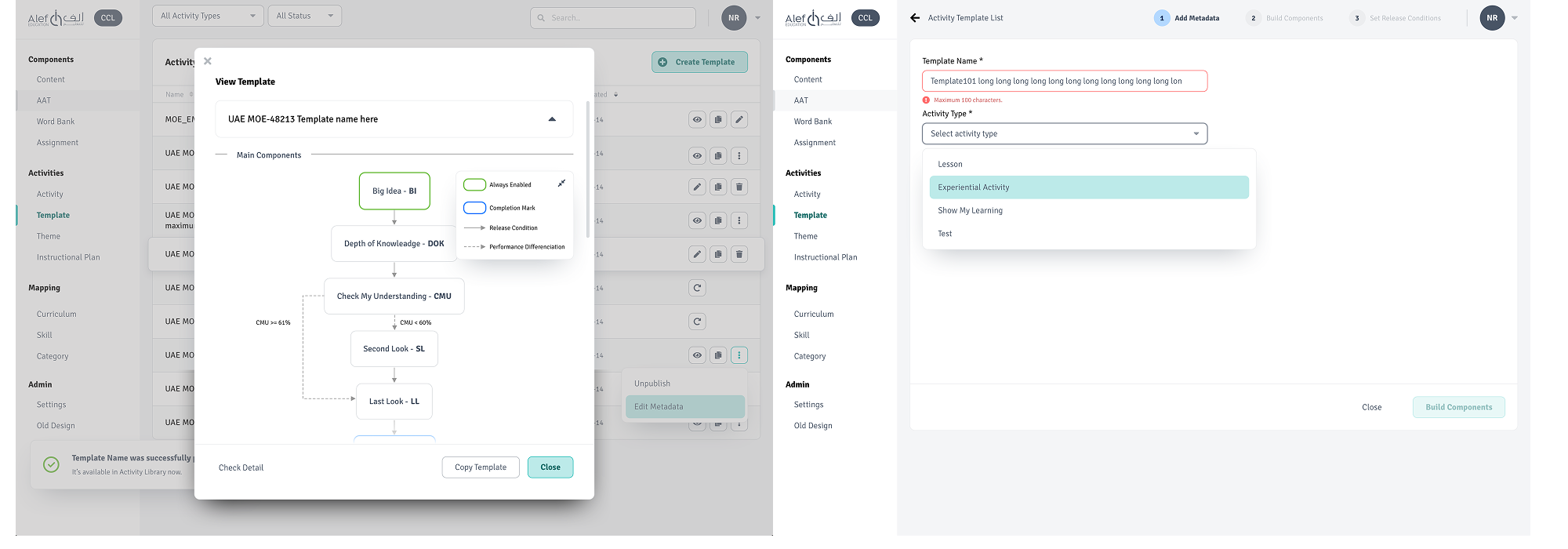
Two of the production screens: the template library with the View-Template flow — Big Idea → Depth of Knowledge → Check My Understanding, each with release conditions — and the metadata step of the template wizard.
 View full size
Design review and the design system
In parallel I was a key contributor to the Alef design system — built the proof-of-concept with the dev team and documented the design principles with the lead UI designer.
I also initiated the cross-team design review: designers from different product teams critiquing each other's work on a standing cadence. It outlived the project.
Where it landed
The authoring surface shipped to production — the screens above are the live tool. There is no outcome metric from this period. What stands: the shipped surface itself, and the four-block contract designed so new templates couldn't break consumer apps, stress-tested against real regional flows before build.